How to Get Your Journal Indexed in Scopus – Scopus is a trusted abstract and citation database that covers a wide range of disciplines, including Life Sciences, Social Sciences, Physical Sciences, and Health Sciences. Many academic universities and publishers trust Scopus; however, at the same time, some universities do not.
If you are looking to get your journal indexed in Scopus, then you are in the right place. In this blog, i am going share some important details and guidelines about Scopus that can help you in the indexing process.
First, let’s talk about why it matters to have your journal indexed in Scopus. Since many universities trust Scopus, journals indexed in this database can gain significant advantages. Scopus provides global visibility for your journal because many universities and academic institutions use it as one of the most authentic academic resources. If your journal is indexed in Scopus, it can easily gain wider visibility, ultimately helping it grow and improve its impact factor.
If you are a journal editor or publisher aiming to get your journal indexed in Scopus, this guide will walk you through the essential steps.
Understand Scopus Selection Criteria
Before applying for Scopus indexing, your journal must meet Scopus’s minimum technical criteria:
Scopus Selection Criteria
Peer Review: The journal must follow a rigorous peer-review process.
English Titles & Abstracts: Even if the full articles are in another language, titles, abstracts, and keywords must be in English.
Regular Publication: Journals must have a consistent publishing schedule.
Roman Script References: The references in articles should be in Roman script for global accessibility.
Ethical Standards: The journal should follow ethical publishing practices, ideally aligned with COPE (Committee on Publication Ethics).
Strengthen Your Journal’s Editorial Standards
Scopus has an independent Content Selection & Advisory Board (CSAB) that evaluates journals. Here’s what they look for:
Editorial Policy: Clearly defined aims, scope, and submission guidelines.
International Representation: Editors and authors should be from diverse geographic backgrounds.
Academic Contribution: The journal should make a significant impact in its field.
Abstract Clarity & Article Readability: Ensure well-written abstracts and high-quality research articles.
Citation Performance: Existing articles should be cited in other reputable sources.
Tip: Having experienced researchers and professors on your editorial board increases credibility.
Prepare a Strong Online Presence
Your journal must be available online with a well-maintained website that includes:
A professional homepage with journal details and ISSN.
Submit your application via the official Scopus Suggestion Portal: Title Suggestion form
Note: The review process can take several months to a year. Be patient and continue improving your journal.
Post-Evaluation & Continuous Monitoring
Scopus continuously evaluates indexed journals to maintain high quality. If a journal underperforms, it may be flagged for re-evaluation and even delisted.
Tip: Stay updated with Scopus policies and engage in ethical publishing practices.
Final Thoughts
Getting indexed in Scopus is a challenging but rewarding process. By ensuring high-quality content, international visibility, and ethical publishing, your journal stands a strong chance of Scopus acceptance.
If you need further assistance, consider consulting Scopus’s Pre-Evaluation Service to assess your journal’s readiness.
Want to launch a high-impact journal?
📩 Contact me for expert guidance on indexing, publication standards, and journal visibility!
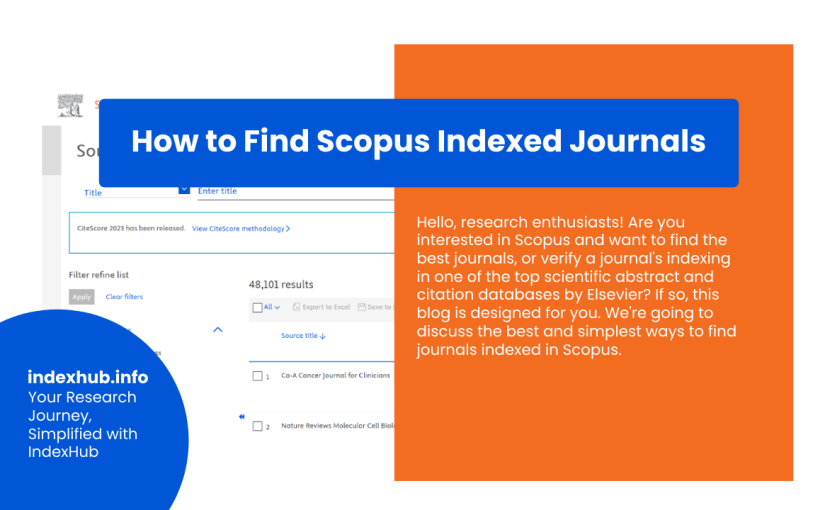
How to Find Scopus Indexed Journals – Hello, research enthusiasts! Are you interested in Scopus and want to find the best journals, or verify a journal’s indexing in one of the top scientific abstract and citation databases by Elsevier? If so, this blog is designed for you. We’re going to discuss the best and simplest ways to find journals indexed in Scopus.
First, let’s talk about what Scopus is. Scopus is a scientific abstract and citation database developed by Elsevier. According to recent reports, there are over 46,534+ journals indexed in Scopus.
Scopus is a reliable source of indexed journals for Life Sciences, Social Sciences, Physical Sciences, and Health Sciences disciplines.
Now, let’s discuss how to find Scopus-indexed journals in easy steps.
Steps to find Scopus Indexed Journals
If you want to find Scopus-indexed journals, first visit the official Scopus website at www.scopus.com
official Scopus website
Now, click on the “Sources” button to access the journal list, as shown in the image below.
How to Find Scopus Indexed Journals – setp 2
Here, you’ll find a list of Scopus-indexed journals along with their CiteScore and citation data. The top journals will appear on the first page.
List of Scopus Journals
Here, you can search for journals by title, ISSN, subject, or publisher name. Simply choose any option based on how you want to find a journal.
How to Find Scopus Indexed Journals – setp 4
In my case, I am searching for a journal by Subject area. Simply select the “Subject Area” option, then choose the desired subject and click in apply button, as shown in the image below.
Finding journal by subject area
Once you click on the blue “Apply” button, you will see a list of journals based on the subject area you selected.
List of journals by subject
Now, click on any journal title to check its indexing status in Scopus. In my case, I am clicking on the first option, “CA: A Cancer Journal for Clinicians.”
Click in first option
Once you click on the journal title, you will be able to see the journal’s indexing status in Scopus along with other details such as Scopus indexing coverage, publisher, ISSN, subject area, and various metrics like CiteScore, SJR, and SNIP, as shown in the image below.
Scopus indexing status
When checking the indexing status of a journal, be sure to review the details carefully in the journal section. Many people mistakenly assume that if a journal appears in Scopus, it is indexed in Scopus, but this is not always the case. For example, as shown in the screenshot below, the journal is listed as “covered by Scopus: from 2009 to 2021.” This means that if you are looking at the journal in 2023-24, it is no longer indexed in Scopus, as Scopus coverage only goes up to 2021. So, be cautious and verify the information thoroughly.
Scopus coverage only goes up to 2021
I hope this post has clarified things for you, and now you can easily find Scopus-indexed journals or verify a journal’s indexing status in Scopus (Downlaod Scopus Indexed Journals).
If you’re still facing any difficulties or have trouble understanding the post, don’t hesitate to comment below or connect with me on LinkedIn. I’ll be happy to help clear up any doubts and assist you in finding the journals.
I hope this post has added value to your knowledge. If so, please leave a thoughtful comment on the blog post or follow me on LinkedIn for future updates.
Looking for Free Scopus Indexed Journals For Fast Publication? You’re in the right place!, in this blog post we are going to share almost 8+ journals where you can publish your paper quickly. These journals are indexed in Scopus and other prestigious databases.
Journal: American Journal of Medicine Publisher: Elsevier ISSN: 0002-9343 Subject: Medicine, General Medicine Impact Factor: 5.1 CiteScore: 6.3 SJR: 1.063 SNIP: 1.044 Acceptance rate: 14%
Journal: Asian Bioethics Review Publisher: National University of Singapore ISSN: 1793-9453 Subject: Arts and Humanities, Nursing, Medicine Impact Factor: 1.3 CiteScore: 6.2 SJR: 0.620 SNIP: 0.971
Journal: Medicine, Health Care and Philosophy Publisher: Springer Nature ISSN: 1572-8633 Subject: Medicine, Arts and Humanities, Social Sciences, Social Sciences Impact Factor: 2.3 CiteScore: 4.3 SJR: 0.659 SNIP: 1.286
Journal: Irish Journal of Medical Science Publisher: Springer Nature ISSN: 0021-1265 Subject: Medicine Impact Factor: 1.7 CiteScore: 3.7 SJR: 0.532 SNIP: 0.683
Journal: Hospital Practice Publisher: Taylor & Francis ISSN: 2154-8331 Subject: Health Professions CiteScore: 2.8 SNIP: 0.533 Acceptance rate: 27%
Finding free Scopus-indexed journals with fast publication can be challenging, but with careful selection, researchers can identify reputable journals that meet their needs. The journals listed above offer credible publishing opportunities without article processing charges (APCs) while ensuring a peer-reviewed and indexed publication.
However, it is always recommended to verify a journal’s indexing status directly on the Scopus website to avoid predatory or discontinued journals. Additionally, submitting a well-prepared manuscript and following the journal’s submission guidelines can significantly improve the chances of quick acceptance and publication.
How to Choose the Right Journal – With so many options to publish your research in this digital era, it is crucial to select the one journal that aligns with your research goals. Choosing a journal to publish research can be quite challenging for authors. Various factors like submitting to an inappropriate journal, publishing the manuscript in a journal that’s rarely accessed, or rejection of the manuscript can lead to publication delay. A good journal choice makes your hard work fruitful and increases the chances of your research reaching the right audience.
If you feel overwhelmed by the choices, don’t worry! This guide will help you select the perfect “ONE” journal for your research.
Why Choosing the Right Journal Matters
Selecting an appropriate journal for your research manuscript is crucial for several reasons:
#1. Enhanced Visibility and Readership
The main aim should be to reach the audience who can most likely benefit from your research and whether or not a particular journal will help you achieve this goal. The number and the type of audience a journal attracts are important when choosing to publish.
The reach of a journal is higher when there are larger circulations or when it is easily accessible. In this digital era, journals that can be accessed for free online have the potential to reach a wider audience including academics, practitioners, and policymakers.
To reach as many readers as possible, publishing your research in an open-access journal may be beneficial since it allows anyone to read your article for free.
#2. Increased Citations
Citations are used as an indicator of the impact of scientific publication. The number of times a paper has been cited is an indicator of its value to other researchers.
It also can be used to assess the productivity of research groups, scientists, etc. Publishing in open-access journals can increase the chances of your paper being cited (Open Abstract – Increase your article citations and visibility).
#3. Career Advancement
Having a long list of publications in reputed journals in your resume contributes to a solid career foundation, promotions, and faster growth. Documenting your publication can not only strengthen your resume but also give you a competitive edge and open opportunities for pursuing higher education (doctoral/residency programs and university research positions).
The Medical Council of India stipulated that medical teachers need to publish at least two research papers at every step of promotion to be eligible for the posts of associate professor or professor in medical colleges.
#4. Ensured Quality
Journals that are indexed in recognized databases with high impact factors are considered to be of high quality. These journals ensure a trustworthy peer-review process, and publishing in such journals is considered prestigious.
How to Choose the Right Journal for Your Research Key Factors and Tools
#5. Higher media visibility
Digital platforms have reshaped pharmaceutical marketing, enabling companies to connect with their target audience more effectively. Websites, social media, and online advertisements serve as key channels for sharing information on medications and treatments. While data-driven marketing enhances engagement, ethical and regulatory challenges remain.
Publishing research in reputable, peer-reviewed journals is a key strategy for ethical pharmaceutical marketing. Well-conducted studies offer scientifically validated, unbiased information, retaining brand credibility, building trust with doctors, and ensuring regulatory compliance. Choosing the right journal ensures rigorous peer review, adherence to ethical publishing standards (such as COPE), and protection against misleading marketing practices.
Risks of Not Choosing the Right Journal
Failing to choose an appropriate journal can lead to several negative outcomes:
#1. Manuscript Rejection
Manuscript rejection is very common. Journals that are of high quality or more prestigious tend to have a higher rejection rate.
There are several reasons why a manuscript may be rejected. According to a study, the top 10 reasons for rejection of manuscripts are:
Poorly written manuscript
Inappropriate research topic
Poor hypothesis
Poor design or methodology
Small sample size/short follow-up
Ethical misconduct
Plagiarism
Out of scope of journal
Results are not based on established criteria
Inappropriate discussion
The conclusion not match the research question
The acceptance rate in reputed journals is around 10%-20%. This means it is already a challenge to get your research accepted and published in these journals.
Reason of Manuscript Rejection
#2. Use of AI in writing
It is also important to ensure whether your targeted journal allows the use of AI for writing support. If the journal allows, it is important to honestly acknowledge the use of AI while you, as an author, will have to take full responsibility for the final submitted file.
The International Committee of Medical Journal Editors (ICMJE) updated their recommendations in January 2025. It is important to read and understand the guidelines if you want to choose the right journal.
#3. Reduced Credibility
Publishing your research in a journal that is not reputable can not only harm the credibility of your research but also affect your career prospects and may result in limited reach and impact of your research.
They mislead you by falsely claiming that they provide peer review, hide information regarding the author fees, violate copyrights, etc.
#4. Limited Impact
Reduced Visibility: Both new and experienced researchers can make the mistake of submitting their work to an inappropriate journal. Even valuable work may go unrecognized if the right journal is not chosen. Making this mistake affects the time, money, and even the motivation of the researcher.
Fewer Citations: It is important for the research to be discovered and read by others. Citations measure the spread of new knowledge, recognize the contribution of peers, and, in many fields, serve as the basis of professional reward. It can also change the perception of quality. A paper with a low citation count may be seen as low quality and is read superficially.
Missed Opportunities for Collaboration: Publishing your research and disseminating the knowledge helps peers and professionals benefit from new information, whether it’s a novel concept or an unusual finding. Publishing in poor-quality journals is not considered a scientific contribution to knowledge. Hence, your research may not be discovered and may also hinder opportunities for collaboration.
Diminished Influence on Policy and Practice: Effective dissemination of research is needed to bridge the gap between research and policy and practice. This is possible only if the information finds and attracts the right audience. Therefore, it is crucial to make the right choice of the journal.
Consequences of Poor Journal Selection – How to Choose the Right Journal for Your Research
Key Factors to Consider When Choosing a Journal
When choosing a journal, there are several key factors you should consider:
#1. Scope and Audience
The aim is not merely to publish your research but to engage a broader audience. Ensure that the readers of your target journal match the target audience. You can check the “most cited” or “most downloaded” list of articles from your list of target journals to see whether your manuscript is similar in scope to these articles.
Publishing in a reputable journal can lead to greater visibility and reach for your work. The journal’s aims and scope are usually available on its website. It is important to verify whether the journal publishes research similar to yours, considering aspects such as the topic, its novelty, focus, and potential impact. Even exceptional research papers may face rejection if the topic doesn’t align with the journal’s aims and scope.
How to choose the right journal for publication
#2. Journal Metrics
Journal metrics are tools to assess the performance of the journal and authors. There are different metrics that are used, such as the journal impact factor, cite score, h-index, and many more.
Impact factor is the most common method used for assessing the quality of the journal and is considered by many institutions, funding agencies, and university committees for evaluating a paper. Journals having a higher impact factor usually have a good profile and may boost the visibility of your research.
Exploring Journal Metrics
#3. Indexing and Abstracting
To improve the visibility of your article, make sure that your target journal is included in online databases such as PubMed® and Scopus®, as these sources are widely utilized by researchers in the biomedical sciences.
Should a journal prioritize indexing in reputable databases to enhance visibility and submission quality?
#4. Avoiding Predatory Journals
Publishing your research in a predatory journal can have negative consequences due to the limited visibility and impact.
These journals are considered to be low-quality and unreliable and tend to publish almost every submission. Such journals are often not cited in popular databases, making it difficult for other researchers to recognize and use them.
Submitting your work to these journals also means there are possibilities of your work not being published, being published before you sign a publishing agreement, or being removed without any notice.
Predatory journals exploit authors, damaging their reputations
Use tools like Think. Check. Submit. or databases like Cabell’s Predatory Reports to verify a journal’s authenticity.
Think. Check. Submit. is a tool designed to help researchers identify trustworthy journals and publishers for their work. It is a resource to assist in avoiding predatory journals, which exploit authors by charging publication fees without providing legitimate editorial and peer-review services.
The Director of Open Access Journals (DOAJ), The Committee on Publication Ethics (COPE), SCImago Journal Rank, National Library of Medicine (NLM) Catalog, or subscription sources like Cabells’ Blacklist, Journal Citation Reports (JCR).
Avoiding Predatory Journals
#5. Open Access vs. Subscription-Based
Publishing your paper in open access means that your research paper is available to all readers for free, without having the reader subscribe/pay to the journal. Although your research paper may reach the right audience, publishing in an open-access journal is very expensive.
How to Choose the Right Journal for Your Research – Open Access or Subscription-based Journal
Types of Open Access:
Understanding Open Access Models – types of oa
Green open access:The accepted article can be accessed for free on a nonprofit repository or personal/institutional website with the copyright retained by the publisher.
Gold open access:The published article can be accessed for free on the publisher’s website with the copyright and ownership retained by the author.
Hybrid open access:Some of the content published is free while others are subscription-based. Depending on the journal policy or author’s decision, there is an option of “delayed open access” too.
Diamond/Platinum open access: The journals publish articles for free as these are funded by institutions, advertising, philanthropy, etc.
Bronze open access: The journals publish articles that can be accessed online for free but don’t have a license and are not available for reuse.
#6. Peer-Review Process
The hallmark of a reputable journal is a transparent peer review process. The journal’s website will clearly outline the process—how the reviewers are selected, what criteria they use, the expected timeframe, and how the editorial board manages this process.
The journal’s website should also provide details on confidentiality, handling conflicts of interest, and other ethical standards for peer reviewers.
How should the research be published – peer review and guidelines
#7. Readership and Reach
Journals with a higher scope often have a large readership. It is important to identify the interests of the audience and ensure that the journal’s readership matches with your target audience and has a meaningful impact.
You should choose a journal based on your topic. For example: If your topic addresses a particular specialty, it is better to submit to a specialist journal than a general medical journal, as they are more likely to publish it.
#8. Tools and Tips
Here are some practical steps to take when researching a journal:
Review Past Issues: Search the keywords or the title of your article/research manuscript in databases like PubMed and Medline and identify previously published studies that are similar to yours and the journals where they were published. If you have shortlisted a journal to publish your research, check in the search bar in the journal’s website to evaluate if they publish similar research.
IndexHub.info: Explore a free database of journals categorized by discipline, scope, and open-access status.
Consult Peers and Mentors: Selecting a journal needs some experience and effort. It would be helpful to seek guidance from your peers or mentors, especially first-time authors. You can also drop an email to us support@indexhub.info, and info@indexhub.info if you want to find the right journal for your research.
Benefits of Thorough Journal Selection
Benefits of Thorough Journal Selection
By carefully selecting the right journal, you can:
Increase Research Impact: Publications not only recognize and validate the author’s effort but also ensure their research is preserved for future generations.
Improve Collaborations: Publishing your research is a form of showcasing your work to the world. This not only can benefit your peers but also can increase the opportunities for networking and collaboration.
Enhance Professional Recognition: Publishing can bring recognition, and it serves as a reliable basis for assessing one’s expertise in a field.
Long-Term Credibility: Research and publication can open doors for further education (doctorates, university research positions, and even residency applications).
Policy and Practice: Evidence from research has the potential to influence changes in policy and practice and decision-making even though it has not been widely recognized.
Funding Opportunities: The chances of obtaining support for further research are easier when you have a solid publication history.
Understanding Journal Metrics
Metrics for Evaluating Journal Quality
Impact Factor (IF): The journal impact factor is widely recognized as the most common indicator to evaluate the impact of the journal based on the Web of Science data. It is a number that shows how often the articles published in that journal are cited and indicates the quality of the journal. Impact factor is published every year, and the calculations are based on the number of citations within a certain timeframe.
CiteScore: This metric from Elsevier measures the citations a journal receives over three years.
h-index: This metric assesses the productivity and citation impact of a journal. It indicates the number of articles that have received at least that many citations.
SJR (SCImago Journal Rank): This metric is a prestige indicator which weights citations based on the source of the citation, with more prestigious journals having more influence.
SNIP (Source Normalized Impact per Paper): This metric normalizes field effects by accounting for differences in citation behaviour across disciplines.
Journals with a higher impact factor are generally more well-known, which can increase the chances of your article’s visibility. However, it is important to assess whether your research is genuinely a good fit for a journal with a high impact factor before submitting your manuscript.
Apart from the above metrics, there are usage metrics and alternative metrics (altmetrics) that are also used to evaluate the quality of scientific literature.
Need Further Assistance?
Choosing the right journal is a critical step in your research journey, and this guide covers the essential factors and tools to make an informed decision. However, if you still feel unsure or need personalized guidance, feel free to reach out—I’d be happy to help you navigate the process!
Conclusion
Selecting the right journal can be a challenging process that takes time and effort. Taking the time to carefully research and choose an appropriate journal can make a big difference in the visibility and success of your publication.
NMC Approved Journals – For medical professionals in India, publishing research in reputable journals is crucial for career advancement, academic recognition, and contributing to the medical field. The National Medical Commission (NMC) plays a vital role in ensuring the quality and credibility of medical research by maintaining a list of approved journals.
What are NMC Approved Journals?
NMC approved journals are scholarly publications that meet the criteria set by the National Medical Commission. These journals are recognized for their rigorous peer-review processes, adherence to ethical publishing practices, and their contribution to advancing medical science. Publishing in such journals is highly regarded, as it signifies quality and credibility.
NMC Faculty Promotion Guidelines
The National Medical Commission (NMC) of India updated its guidelines for faculty promotions in February 2022. Now, only research publications in highly-regarded journals will be considered. These journals must be indexed in at least one of the following databases/NMC Approved Indexing:
Below in our list, we have provided some of the best journals as per NMC guidelines. If you wish to download the updated list of NMC-approved journals in PDF or Excel format, click the link above to access the latest list.
NMC Approved Journals List
Higher Education for the Future ISSN: 2347-6311 Publisher: SAGE Category: Social Sciences, Education Abstract & Indexing: Scopus, UGC, ProQuest Acceptance rate: 5.6%
Hepatology International ISSN: 1936-0533 Publisher: Springer Nature Category: Medicine, Hepatology Abstract & Indexing: EMBASE, Medline, ProQuest, Scopus, UGC Impact Factor: 5.9 Submission to first decision: 10 days
Endoscopic Ultrasound ISSN: 2303-9027 Publisher: Wolters Kluwer Health Category: Medicine (Radiology, Nuclear Medicine and Imaging, Gastroenterology, Hepatology) Abstract & Indexing: Scopus, EMBASE, PubMed Central, Web of Science Impact Factor: 4.5
Asian Journal of Social Health and Behavior ISSN: 2772-4204 Publisher: Wolters Kluwer Health Category: Social Sciences, Psychology, Medicine Abstract & Indexing: DOAJ, Scopus, Web of Science, Emerging Sources Citation Index Impact Factor: 5
Global Journal of Flexible Systems Management ISSN: 0972-2696 Publisher: Global Institute of Flexible Systems Management Category: Business, Management and Accounting Abstract & Indexing: Scopus, UGC-CARE, ProQuest Submission to first decision: 5 days
Linguistic and Philosophical Investigations ISSN: 1841-2394 Publisher: Addleton Academic Publishers Category: Arts and Humanities Abstract & Indexing: Scopus, ProQuest, EBSCOhost, Hinari Acceptance rate: 16%
Physiology and Molecular Biology of Plants ISSN: 0971-5894 Publisher: Springer Nature Category: Agricultural and Biological Sciences, Biochemistry, Genetics and Molecular Biology Abstract & Indexing: EBSCO, Scopus, UGC-CARE, CAB Abstracts, PubMed Central Impact Factor: 3.4 Submission to first decision: 17 days
Asian Journal of Andrology ISSN: 1008-682X Publisher: Wolters Kluwer Health Category: Medicine Abstract & Indexing: Scopus, DOAJ, Science Citation Index Expanded, Web of Science Impact Factor: 3
Journal of Orthopaedics ISSN: 0972-978X Publisher: Elsevier Category: Medicine (Orthopedics and Sports Medicine) Abstract & Indexing: Scopus, PubMed Central (PMC), Emerging Sources Citation Index (ESCI) Acceptance rate: 37% Impact Factor: 1.5
Indian Journal of Pediatrics ISSN: 0019-5456 Publisher: Springer Nature Category: Medicine (Pediatrics, Perinatology and Child Health) Abstract & Indexing: Medline, Scopus, UGC-CARE, Embase, ProQuest Impact Factor: 2.1 Submission to first decision: 6 days
Urogynecology ISSN: 2771-1897 Publisher: Wolters Kluwer Health Category: Medicine Abstract & Indexing: Scopus, PubMed
Journal of Food Science and Technology ISSN: 0022-1155 Publisher: Springer Nature Category: Agricultural and Biological Sciences Abstract & Indexing: Scopus, ProQuest, PubMed Central, SCImago Impact Factor: 2.6 Submission to first decision: 44 days
Medical Gas Research ISSN: 2045-9912 Publisher: Wolters Kluwer Health Category: Medicine, Neuroscience Abstract & Indexing: Web of Science, PubMed, Scopus, Index Medicus Impact Factor: 3
Publishing in NMC approved journals is a significant milestone for medical professionals. By understanding the criteria for journal approval and following best practices for publication, researchers can effectively disseminate their findings and contribute to the advancement of medical science.
Fast Publication Indexed Journals – In the competitive world of academic publishing, getting your research published in a Scopus, WOS, and Pubmed indexed journal quickly is a priority for many researchers.
This guide explores the concept of Fast Publication Indexed Journals, providing insights into choosing the right journal and tips for expediting your publication process.
Advances in Oceanography and Limnology ISSN: 1947-5721 Indexed In: Scopus, DOAJ APC: No Publication Fees Review Process: Anonymous peer review Submission to publication: 12 weeks Subject: Science: Biology (General): Ecology
Journal of Engineering, Project, and Production Management ISSN: 2221-6529 Indexed In: Scopus, DOAJ APC: No Publication Fees Review Process: Double anonymous peer review Submission to publication: 12 weeks Subject: Business, Management and Accounting, Engineering
Journal of Small Business Strategy (Not publishing anymore) ISSN: 1081-8510 Indexed In: Scopus, DOAJ APC: No Publication Fees Review Process: Double anonymous peer review Submission to publication: 4 weeks Subject: Business, Management and Accounting
European Psychiatry ISSN: 0924-9338 Indexed In: Medline/PubMed, Clarivate, Scopus, DOAJ APC: $3150 USD Review Process: Anonymous peer review Submission to publication: 6 weeks Subject: Medicine, Psychiatry and Mental Health
European Journal of Case Reports in Internal Medicine ISSN: 2284-2594 Indexed In: PubMed Central, Scopus, DOAJ APC: 300€ + 22% VAT (366€ tax incl) Review Process: Single-blind peer-review Submission to publication: 8 weeks Subject: Medicine (Internal medicine, Young internist, Case report, Educational value)
Indian Journal of Clinical and Experimental Ophthalmology ISSN: 2395-1443 Indexed In: Scopus APC: $250 (USD) Review Process: Double blind peer review Submission to publication: 5 weeks Subject: Clinical Ophthalmology, Ophthalmology
Frontiers in Conservation Science ISSN: 2673-611X Indexed In: WOS, Scopus, DOAJ APC: $0-2206 USD (Article type wise) Review Process: Anonymous peer review Submission to publication: 13 weeks Subject: Environmental Science, Nature and Landscape Conservation
Health Technology Assessment in Action ISSN: 2645-3835 Indexed In: Scopus, DOAJ APC: No Publication Fees Review Process: Double anonymous peer review Submission to publication: 12 weeks Subject: Health Professions, Medicine
Medical Journal of Babylon ISSN: 1812-156X Indexed In: SCOPUS, DOAJ APC: $200 USD Review Process: Double anonymous peer review Submission to publication: 8 weeks Subject: Medicine
European Geologist ISSN: 1028-267X Indexed In: DOAJ APC: No Publication Fees Review Process: Anonymous peer review Submission to publication: 8 weeks Subject: Science: Geology
Fast Publishing Scopus Indexed Journals – In today’s competitive academic landscape, publishing in Scopus-indexed journals is crucial for researchers aiming to establish credibility and enhance their professional standing.
However, the lengthy peer-review and publication processes often pose challenges for those working on time-sensitive projects.
This article explores strategies to achieve fast publication in Scopus-indexed journals, guiding researchers from manuscript preparation to final publication.
Before we start to Fast Publishing Scopus Indexed Journals, make sure the journal you’re targeting is still actively publishing. Some Scopus-indexed journals may have been discontinued. You can find a list of discontinued titles on our Scopus Discontinued Titles page.
Fast Publishing Scopus Indexed Journals
Acta Histochemica Impact factor: 2.3 CiteScore: 4.6 Acceptance rate: 9% Time to first decision: 3 days
Postgraduate Medicine Impact Factor: 2.6 CiteScore: 6.1 SNIP: 0.868 Acceptance rate: 10% Time to first decision: 5 days
Amino Acids Impact Factor: 3.0 CiteScore: 6.4 Time to first decision: 10 days
Scopus, one of the largest abstract and citation databases, periodically reviews journals to maintain quality standards. This process often results in some titles being discontinued. These changes impact researchers, academic institutions, and publishers. In this post, we’ve compiled a list of journals recently removed from Scopus and the reasons behind their discontinuation.
Why Does Scopus Discontinue Journals?
Scopus evaluates journals based on rigorous criteria, including publication ethics, peer review quality, citation metrics, and indexing standards. Common reasons for discontinuation include:
Corporate Governance and Organizational Behavior Review
EAI Endorsed Transactions on Scalable Information Systems
Economic Affairs (New Delhi)
Educational Administration: Theory and Practice
European Journal of Medical Research
International Journal of Applied Economics, Finance and Accounting
International Journal of Information Technologies and Systems Approach
International Journal of Intelligent Systems and Applications in Engineering
International Journal of Pharmaceutical Quality Assurance
Journal of Biotech Research
Journal of Engineering and Applied Science
Journal of Health and Translational Medicine
Journal of Higher Education Theory and Practice
Journal of Logistics, Informatics and Service Science
Journal of Medicine and Life
Journal of System and Management Sciences
Journal of Wildlife and Biodiversity
Nurture
Pharmacy Education
Revista De Gestao Social e Ambiental
Revista Electronica de Veterinaria
Revista Iberoamericana de Psicologia del Ejercicio y el Deporte
Scientific Herald of Uzhhorod University. Series Physics
Uncertain Supply Chain Management
Universal Journal of Agricultural Research
Acta Medica Mediterranea
Advances in Multimedia
Annals of Medicine and Surgery
Annals of Palliative Medicine
Applied Bionics and Biomechanics
Arhiv za Farmaciju
Axioms
Azerbaijan Pharmaceutical and Pharmacotherapy Journal
Biomedicine (India)
Bionatura
Cancer Research, Statistics, and Treatment
Computational and Mathematical Methods in Medicine
Contemporary Voice of Dalit
Contrast Media and Molecular Imaging
Disease Markers
European Journal of Contemporary Education
Evidence-based Complementary and Alternative Medicine
Note for Authors and Researchers:
If you’re planning to publish your article in Scopus-indexed journals, please exercise caution. Many journals continue to claim Scopus indexing even after being discontinued. To avoid potential issues, always verify the journal’s current indexing status directly on the Scopus website before submitting your paper.
If you’re searching for the latest list of Scopus-indexed journals, please download it from the link below: Scopus Indexed Journals